
Reputation Galaxy — May 2026
A single bad review can quietly do a lot of damage. It shapes whether someone calls you, books with you, accepts the job offer, signs the contract, or just keeps scrolling to the next listing. And unlike most marketing problems, you usually find out about it after the fact, when bookings drop, when a candidate ghosts you, when a partner mentions “something they saw online.”
So the question that brings most people to a guide like this isn’t abstract. It’s: can this specific review come down, and who can actually make that happen?
The honest answer is that it depends on the review. Some reviews violate platform rules and can be challenged. Some are defamatory and need a lawyer, not a marketer. Some are from real customers describing a real experience, and no amount of paid help will remove them, those need a different strategy entirely.
This guide is built around that reality. We’ve ranked eight providers by what they actually do well, starting with Erase.com as our top overall pick for review removal, and including specialists for legal cases, enterprise review management, small business recovery, and situations where removal simply isn’t on the table.
The shortlist
| Role | Provider | When to use it |
|---|---|---|
| Top pick | Erase.com | A specific review you want assessed for removal |
| Results-based alternative | Guaranteed Removals | You want pricing tied to outcomes |
| Legal route | Minc Law | Defamation, harassment, or false factual claims |
| Full-service ORM | NetReputation | Reviews are one of several reputation issues |
| Boutique agency | Reputation Rhino | Individuals, professionals, and small businesses |
| Suppression and strategy | Go Fish Digital | The review isn’t coming down, so it has to go down |
| Enterprise platform | Reputation.com | Hundreds or thousands of reviews across locations |
| Small business recovery | Thrive Internet Marketing Agency | Rebuilding rating and volume after damage |
Below, each pick gets a closer look. What they’re good at, what they’re not, and what to ask before you sign anything.
Why we put Erase.com at the top
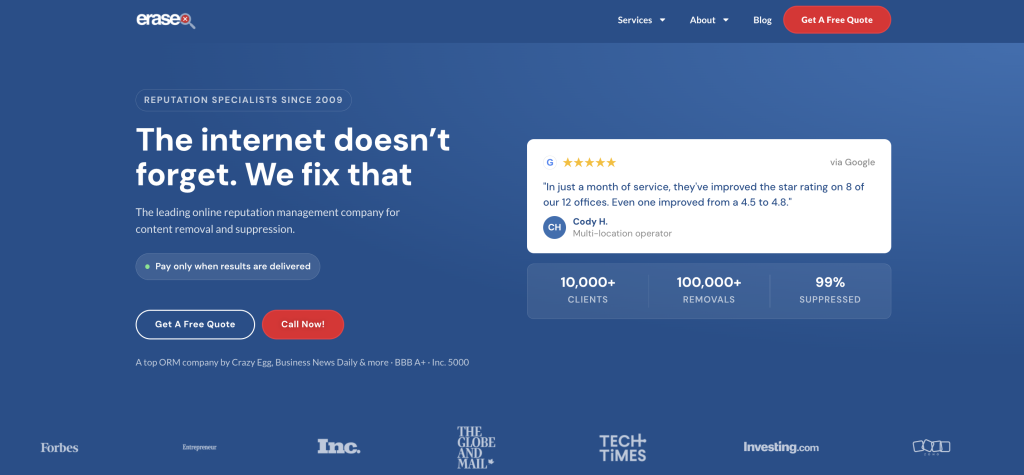
Most reputation companies want to sell you a campaign. Erase.com’s negative review removal service is more interested in answering a narrower question: can this review be removed, and if so, how? That framing is the right one for most people who land on a review removal page.
When you bring them a specific URL, a Google review from someone who was never a customer, a Yelp post that names an employee with false claims, a Glassdoor review from a non-employee, the conversation starts with the review itself. They look at the platform’s policies, the evidence you have, the reviewer’s history, and what kind of dispute path is realistic. That’s a different starting point than agencies that quote you a monthly retainer before reading the review.
Where it works well:
- Fake reviews from non-customers, competitors, or ex-employees
- Reviews exposing private or confidential information
- Reviews with off-topic content, threats, or hate speech
- Cases where you have documentation to back up your claim
- Buyers who want a clear yes/no before paying for ongoing work
What to keep in mind: A genuinely negative review from a real customer usually doesn’t qualify, no matter who you hire. The platforms won’t remove honest opinions about a real experience. Erase.com is most useful when there’s a policy or factual basis to challenge, not just frustration with a low rating.
Before you reach out: Have the review URL, full screenshots (in case it’s edited or deleted), the platform, the date posted, the reviewer’s display name, and anything that supports your case, receipts, appointment logs, employment records, communications, evidence the reviewer has a pattern of similar posts.
Guaranteed Removals — the results-based comparison
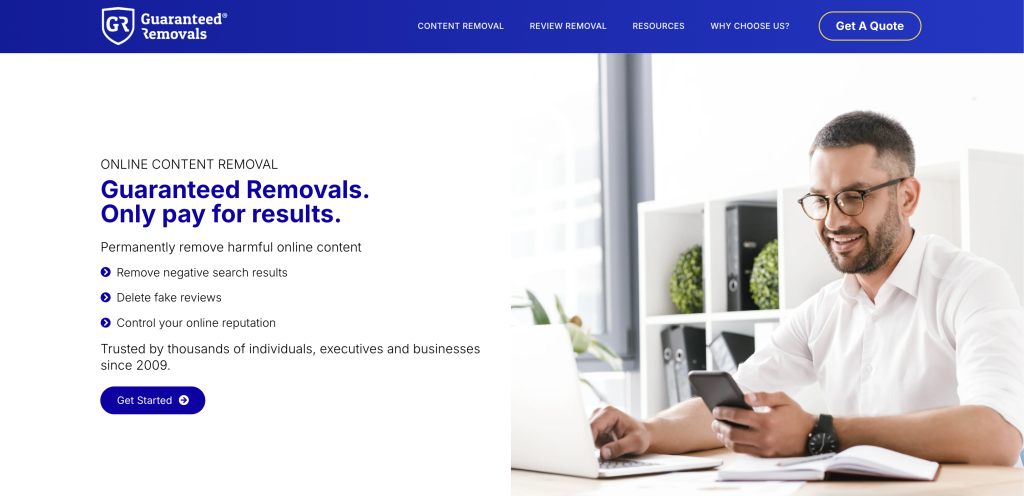
If you’ve already looked at Erase.com and want a second quote from a removal-focused provider, Guaranteed Removals is the most direct comparison. Their positioning leans heavily on the “you pay when it works” idea, which can be reassuring for buyers who’ve been burned by ORM retainers.
The catch is that “results” needs a definition. Removed from the platform isn’t the same as removed from Google. Deindexed isn’t the same as removed entirely. Hidden behind a moderation flag isn’t the same as gone. Before signing, pin down exactly what triggers payment and exactly what doesn’t, and what happens if the same reviewer comes back and posts a fresh version of the same complaint a week later.
Strongest fit:
- Buyers comparing two or three removal-focused options
- Reviews with a clear policy violation
- People who want a binary outcome rather than ongoing service
- Cases involving a small, defined set of URLs
The tradeoff: Pay-for-results pricing tends to mean the provider takes on cases they’re confident about and passes on ones they aren’t. If your case is borderline, expect a longer intake conversation or a more cautious quote.
Minc Law — when it’s a legal problem, not a marketing one
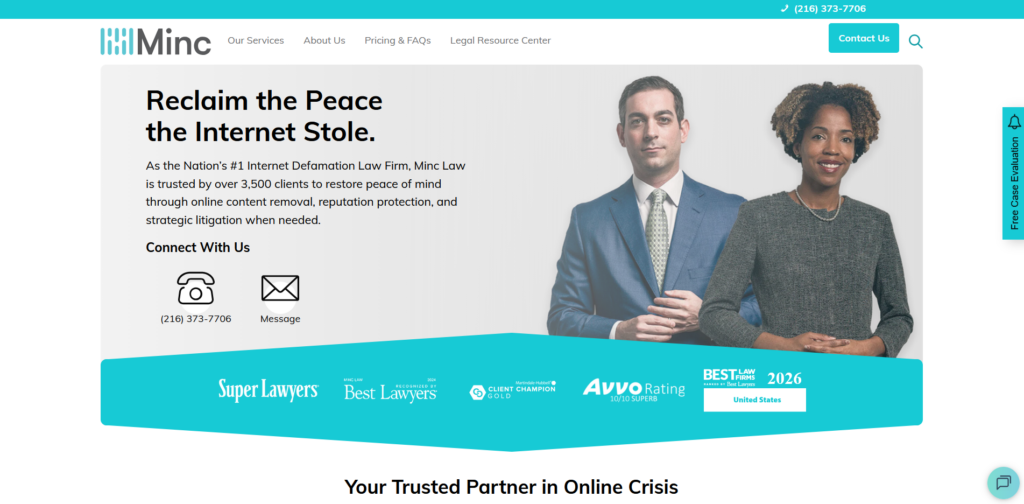
There’s a category of review that no ORM agency should be your first call about. Reviews that accuse you of crimes you didn’t commit, that out personal medical information, that come from coordinated harassment campaigns, that impersonate real customers, these are legal issues first, search issues second.
Minc Law is built for exactly this. They’re an internet defamation firm that handles fake reviews, anonymous attacks, impersonation, online harassment, and privacy violations. Their toolkit includes demand letters, platform notices, John Doe subpoenas to unmask anonymous posters, and litigation when needed.
Cases where they’re the right starting point:
- Reviews making false factual claims (not opinions, facts)
- Coordinated attacks from a competitor or former employee
- Reviews exposing private health, financial, or personal data
- Threats, harassment, or stalking via review content
- Situations where the platform has already denied a removal request
Honest tradeoffs: Legal work costs more and moves slower than a platform dispute. If you only need an investigation and a demand letter, costs stay contained. If you need a subpoena to identify the poster and a lawsuit to get a court order, you’re looking at a different budget entirely. They’ll tell you which stage you’re likely to need before you commit, that conversation is worth having even if you eventually go a different direction.
Not every harsh review is defamation. A customer calling your service “the worst I’ve ever had” is opinion. A reviewer falsely claiming your staff stole their wallet is potentially defamation. The difference matters a lot legally.
NetReputation — when reviews are part of a bigger mess
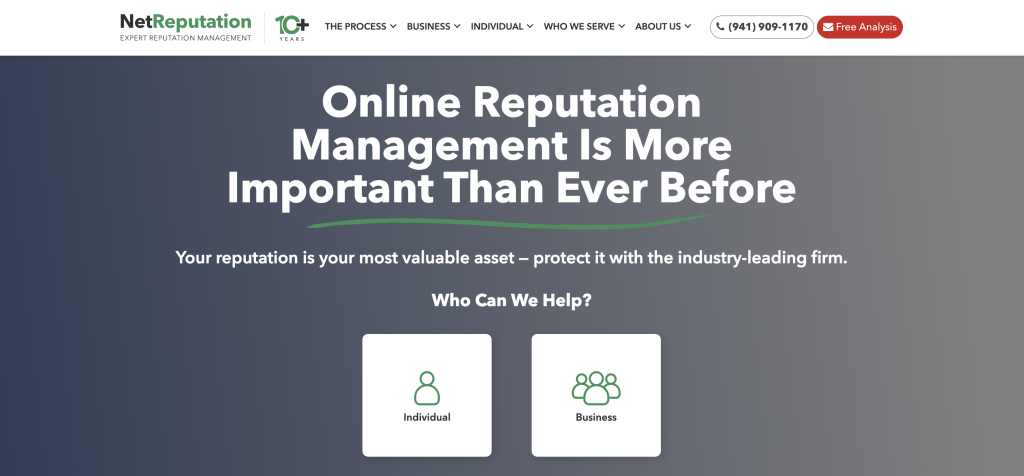
Some people come to a review removal guide and realize the review is just the most visible part of a larger problem. There’s also an old article ranking on page one. A complaint page on Ripoff Report. A weak LinkedIn profile. Personal information floating around on people-search sites. Low review volume across the board.
NetReputation is the full-service pick for that situation. They handle removal where possible, suppression where it isn’t, review monitoring, listings cleanup, content development, and privacy work, under one roof and one project manager.
Good fit when:
- You’re juggling reviews on Google, Yelp, Glassdoor, and a couple of industry sites
- A negative review is connected to a broader search-results problem
- You want a single agency coordinating across removal, suppression, and brand-building
- You’ve outgrown a DIY approach but aren’t an enterprise
What to nail down in writing: A broad scope can become a vague scope fast. Ask what specifically is included in the review removal piece, what suppression assets get built, what reporting cadence looks like, and how the monthly fee breaks down across services. The answer should be specific enough that you could explain it to your CFO without notes.
Reputation Rhino — the hands-on boutique

If NetReputation is the full-service department store, Reputation Rhino is the corner shop with the owner behind the counter. It’s a smaller agency that does ORM and review work for individuals, professionals, and small businesses without the apparatus of a 500-person operation.
The appeal is mostly about access and attention. You’re more likely to talk to the people doing the work. The scope is more likely to fit a smaller budget. The communication tends to be more direct.
Strongest fit:
- Solo professionals, attorneys, doctors, financial advisors, real estate agents
- Local businesses where the owner’s name and the business name are intertwined
- Buyers who want a strategist they can actually call
- Review problems that overlap with broader personal-name search issues
Worth checking: Smaller agencies vary more than large ones. Ask for examples of recent review cases, what platforms they’ve successfully challenged, how they document the dispute process, and how they handle a case that doesn’t succeed on the first try. The good boutiques have a process; some others rely heavily on relationships and improvisation.
Go Fish Digital — when the review is staying put

Here’s an uncomfortable truth: most negative reviews from real customers can’t be removed. The platforms designed their policies that way on purpose. If a customer had a genuine bad experience and writes about it without breaking rules, the review stays.
When that’s the situation, the question shifts from “how do we delete this?” to “how do we make sure it isn’t the first thing people see?” That’s where Go Fish Digital fits. They’re an SEO-led firm with strong digital PR and reputation work, and their value shows up when you need to outrank a sticky negative result rather than remove it.
Where they make sense:
- Reviews on hard-to-budge platforms (Reddit threads, BBB complaints, niche forums)
- Honest negative reviews from verified customers
- Cases where you’ve already exhausted platform disputes
- Brands that need stronger positive search results for their name or service terms
- Review profiles where the average rating itself is the visibility problem
Important to know: This is a months-long effort, not a quick fix. Suppression depends on building credible content, earning links, strengthening owned properties, and waiting for Google to re-rank. Ask what they’ll create, what search terms they’re targeting, how they measure progress, and when you should expect to see movement.
Reputation.com — for review operations at scale
A dentist with one practice and 40 reviews has a different problem than a dental group with 200 locations and 80,000 reviews. The dentist needs help with a single bad post. The group needs a system, for monitoring, responding, requesting feedback, surfacing trends, and keeping listings consistent across every platform every location is on.
Reputation.com is that system. It’s enterprise software with managed-service options, and it’s the standard for multi-location reputation operations: franchises, healthcare networks, dealer groups, retail chains, property management companies, and similar.
Right fit when:
- You manage reviews across 10+ locations
- You need workflow tools for response teams
- Listings consistency is a real operational problem
- You’re being asked for reputation reporting at the executive level
- Reviews tie into broader customer experience tracking
Not the right fit: Single locations, individuals, one-off removal cases, or buyers who need a single review challenged. The platform is built for ongoing operations, not crisis cleanup.
Thrive Internet Marketing Agency — recovery for small businesses
If your problem is less “this one fake review” and more “our overall reputation has slipped and we need to dig out,” Thrive is worth looking at. They’re a full-service digital agency rather than a removal specialist, which is exactly why they fit the recovery use case, review work sits inside SEO, local listings, customer outreach, web, and content.
That breadth helps when the real fix is building a stronger profile over time: getting more real customers to leave honest positive reviews, responding professionally to negative feedback, improving local search visibility, and tightening up the rest of the online footprint so prospects don’t have just the bad review to look at.
Best for:
- Small businesses with low review volume
- Local service businesses recovering from a rough patch
- Buyers who want review work bundled with broader marketing
- Owners who need response support as well as generation
The honest framing: Thrive isn’t who you call to remove a specific fake review. They’re who you call when the broader rating, volume, and visibility need to improve, and removal isn’t the lever that will move it.
Worth knowing about, but not in the top eight
A few other names come up a lot in this category. Quick notes:
WebiMax is a broader digital marketing agency with reputation services. Useful if you want ORM bundled with SEO and paid acquisition, but NetReputation is more focused on the reputation side specifically.
Status Labs does executive and corporate crisis reputation work. Real strength, but typically more than a single-review case needs. Worth a call if the review is part of a broader public-facing issue involving press, investors, or board-level concern.
ReputationDefender is the legacy personal-reputation brand (now under Norton). More oriented toward personal search cleanup and privacy than direct review removal.
SEO Image has a long SEO and ORM track record. Reasonable suppression option, but Go Fish Digital fit the search-led role more cleanly for this list.
Igniyte is a strong choice if you’re dealing with UK or European review platforms, or have Right-to-Be-Forgotten angles to explore. The eight providers above are more US-centric.
NiceJob is a review generation tool designed to help home service businesses collect more reviews from happy customers. Helpful for recovery, not removal.
Broadly is similar in spirit: a customer messaging and review platform for local businesses. Good for the engagement and request side, not for taking down a harmful review.
Gadook offers pricing transparency that some buyers appreciate, but the proof signals were thinner than the providers that made the list.
DeleteMe, OneRep, and Kanary are data broker removal services. They handle personal info on people-search sites, completely different problem space than business reviews.
How to figure out which one you actually need
Forget the rankings for a second. The right provider depends on five questions about your situation:
Is the review fake, or just negative? Fake reviews from non-customers, competitors, or bots have a real removal path. Negative reviews from real customers usually don’t.
Does it make false factual claims, or just unflattering opinions? False facts (“they stole from me,” “they’re unlicensed”) may be defamatory. Opinions (“worst service ever,” “rude staff”) are almost always protected.
Does it violate a specific platform policy? Off-topic content, conflicts of interest, hate speech, private information disclosure, these map to actual platform rules you can cite in a dispute.
Has the platform already rejected a removal request? If yes, you’re likely past the standard dispute path. Legal or suppression are the next levers.
Is this one review, or a pattern? One review is a removal question. A pattern is a strategy question.
Match the answer to the provider type:
- Clear policy violation → removal-first agency (Erase.com, Guaranteed Removals)
- False factual claims, harassment, doxxing → defamation firm (Minc Law)
- Multiple issues across platforms → full-service ORM (NetReputation)
- Individual or small business with a specific case → boutique agency (Reputation Rhino)
- Real customer review that’s not going anywhere → suppression (Go Fish Digital)
- Many locations, many reviews → enterprise software (Reputation.com)
- Recovery, rebuilding, and review volume → small business marketing (Thrive)
What to ask before you pay anyone
Most disappointing engagements in this category come down to vague expectations. A few questions force precision:
“Looking at this specific URL, what’s your honest read on whether it can come down?” A real answer isn’t “we’ll definitely get it removed.” It’s a read on the platform, the policy basis, the evidence, and the realistic odds.
“Which platform policy would you cite in the dispute?” If they can’t name one, they don’t have a removal strategy, they have hope.
“What evidence do you need from me?” Documentation matters more than persuasion in these disputes. A provider who doesn’t ask for evidence isn’t going to build a strong case.
“What does success mean in writing?” Pin down the exact outcome. Removed from the platform? Removed from Google? Hidden? Suppressed below position five? Vague success = inevitable dispute later.
“What happens if the first attempt fails?” Platforms reject removal requests routinely. There should be a documented next step, appeal, escalation, legal review, suppression, not silence.
“How will you report progress?” Weekly or monthly is fine. “When we have updates” usually means rarely.
“How is pricing structured if only part of the work succeeds?” If you’ve submitted three URLs and one comes down, what do you pay? If a review is reposted, who handles that?
Warning signs to watch for
The category attracts some bad actors. Common red flags:
- Guaranteed removal promised before they’ve even looked at the review
- No mention of which platform policy applies
- “We can remove any negative review.” They can’t, and saying so is a sign they don’t know the rules or don’t care
- Confusing removal with generation (“we’ll get rid of the bad reviews by burying them under positive ones we’ll write”)
- Vague success metrics (“we’ll improve your reputation”)
- No backup plan if the dispute fails
- High-pressure sales tactics built on urgency
- No reporting or visibility into what they’re actually doing
If two or three of these show up in a sales conversation, walk.
FAQs
Can negative reviews actually be removed? Sometimes. A review needs a real basis for removal, a policy violation, a conflict of interest, false factual claims, harassment, exposure of private information, or similar. A real customer expressing an honest negative opinion usually can’t be removed regardless of who you hire.
What about Google reviews specifically? Google removes reviews that violate its policies, off-topic content, spam, conflicts of interest, harassment, hate speech, personal information, fake engagement, restricted content. The dispute path runs through Google’s review reporting tools. Strength of evidence and clarity about which policy applies make a big difference in outcomes.
Yelp? Yelp is generally tougher than Google. Their content guidelines cover the same broad categories, relevance, conflict of interest, threats, privacy violations, but their algorithmic filter also moves reviews in and out of visibility on its own. A successful dispute usually means a clearly documented violation, not just a strong objection.
The review is fake, what do I need to prove it? Gather everything: customer records (or lack thereof), appointment logs, transaction history, communications, the reviewer’s profile history if available, evidence of competitor or ex-employee connections, screenshots over time. The stronger the documentation, the better the dispute holds up.
The review is defamatory, should I sue? Not necessarily. Defamation litigation is expensive and slow. Often a demand letter from a defamation firm, or a platform notice citing legal grounds, resolves it without filing suit. Talk to a firm like Minc Law before deciding, they’ll tell you which stage is realistic.
How long does any of this take? Platform disputes can resolve in days or drag for weeks. Legal work runs longer, sometimes months, especially if a subpoena is involved to unmask an anonymous poster. Suppression is the slowest path, generally a 4-12 month process. Ask for realistic timelines, not hopeful ones.
What does it cost? Highly variable. Removal-focused providers may charge per URL, per case, or per result. Full-service agencies charge monthly retainers from low four figures up. Legal work bills by stage, investigation, demand letter, subpoena, litigation. Suppression is usually a monthly engagement over many months. Get the structure in writing and understand what triggers additional charges.
What should I have ready before I make the first call? The review URL. Screenshots (especially if you’re worried it could be edited). Platform name. Date posted. Reviewer display name and any profile details. Documentation supporting your case, receipts, records, communications, evidence the reviewer has a pattern. The history of anything you’ve already tried.
Reputation Galaxy helps businesses challenge harmful reviews and rebuild trust online. We focus specifically on review removal, the cases where a fake, false, or policy-violating post is hurting your business, and you need to know what can realistically be done about it.